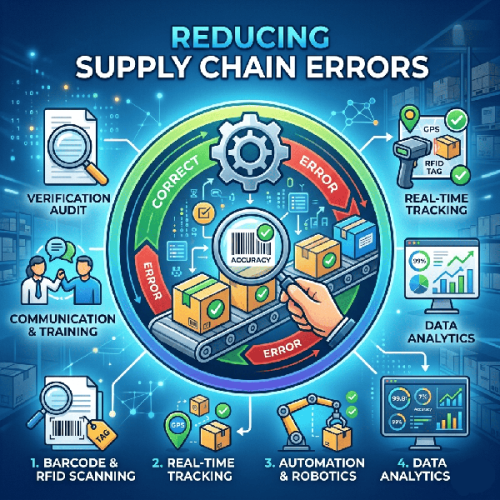
Reducing supply chain errors is a continuous process of moving from reactive troubleshooting to proactive prevention. Errors in the supply chain—whether in data, inventory, or logistics—directly impact your bottom line and customer trust.
1. Eliminate Manual Data Entry
Human error is the leading cause of "paperwork" mistakes in logistics. Transitioning to automated data capture ensures accuracy at the source.
-
Barcode & RFID Scanning: Use scanning at every touchpoint (receiving, picking, shipping) to ensure the physical goods match the digital record.
-
EDI (Electronic Data Interchange): Automate the exchange of documents like Purchase Orders and Invoices with suppliers to prevent transcription errors.
-
Integrated Systems: Ensure your ERP (Enterprise Resource Planning) and WMS (Warehouse Management System) communicate in real-time to avoid inventory discrepancies.
2. Standardize Operating Procedures (SOPs)
Ambiguity leads to errors. Every repetitive task should have a clear, documented workflow.
-
Visual Work Instructions: Use diagrams or photos at packing stations to show exactly how items should be protected and labeled.
-
Uniform Labeling: Implement a standard labeling format for all incoming shipments from suppliers to ensure your warehouse team can process them without confusion.
-
Checklists: Use mandatory digital checklists for complex tasks, such as container loading or hazardous materials handling.
3. Improve Supplier Collaboration
Errors often start before the goods even reach your warehouse.
-
Scorecards: Regularly share performance data with suppliers regarding shipping accuracy and lead times.
-
Early Warning Systems: Encourage suppliers to report potential delays or raw material shortages immediately rather than waiting for the delivery date.
-
Shared Forecasts: Providing suppliers with a rolling demand forecast reduces the "Bullwhip Effect," where over-ordering or under-ordering leads to inventory errors.
4. Implement Robust Quality Gates
Don't wait until the final stage to check for errors. Build "gates" into the entire process.
-
Inbound Inspection: Verify the quantity and condition of goods the moment they arrive at the dock.
-
Cycle Counting: Instead of a once-a-year physical inventory, perform small, frequent counts of high-value or high-velocity SKUs to catch discrepancies early.
-
Weight Verification: For outbound parcels, use "weight-based" checking where the system flags any package that weighs more or less than the theoretical weight of the items scanned.
5. Root Cause Analysis (RCA)
When an error does occur, focus on the "why" rather than the "who."
-
The 5 Whys: A simple technique to drill down into the underlying cause of a failure (e.g., Why was the shipment late? -> The truck broke down. -> Why? -> It missed its maintenance. -> Why? ...and so on).
-
Corrective and Preventive Actions (CAPA): Don't just fix the immediate error; change the process to ensure it cannot happen again.

krishna
Krishna is an experienced B2B blogger specializing in creating insightful and engaging content for businesses. With a keen understanding of industry trends and a talent for translating complex concepts into relatable narratives, Krishna helps companies build their brand, connect with their audience, and drive growth through compelling storytelling and strategic communication.